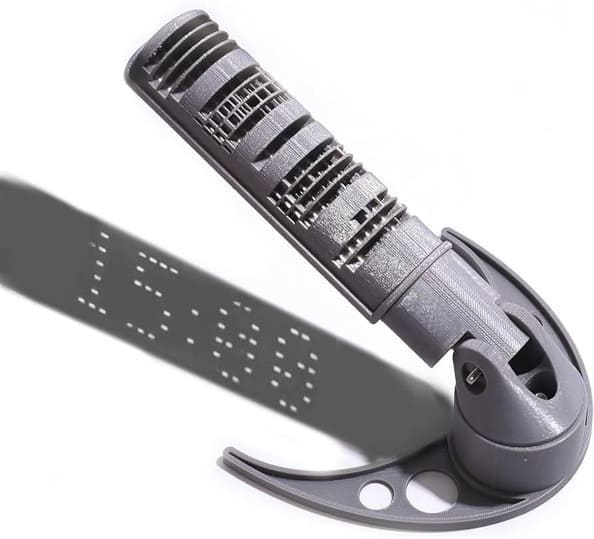
We are accustomed to thinking of sundials as ancient artifacts—flat plates with a triangular gnomon casting a single shadow on Roman numerals. They are beautiful, but they belong to the history books. Julien Coyne, the inventor behind Mojoptix, has reimagined this 5,000-year-old technology for the modern era. He has created a sundial that does not just cast a shadow; it projects the current time in digital numbers.
It sounds like a paradox. How can an analog shadow form digital pixels?
The device is entirely 3D printed, yet it requires no batteries, no electronics, and no motors. It functions as a precise optical shield. Inside the intricate plastic structure are tiny, specifically arranged holes. As the sun moves across the sky, its light passes through these apertures at different angles. The holes are mathematically calculated so that the light filtering through them forms the shape of digits on the ground below. At 10:00 AM, the sun aligns to project "10:00". By noon, the angle shifts to project "12:00".
It is a physical manifestation of digital logic, rendered entirely in plastic and sunlight.
The Constraints of Nature
No system is without its limits, and the digital sundial is bound by the same rules as its ancient predecessors. The clock changes the display in every 20 minutes and it functions only during 10:00 and 18:00, meaning it remains silent for roughly 16 hours of the day.This might be seen as a flaw in a world accustomed to 24/7 connectivity. However, this limitation does not diminish the brilliance of the invention; it highlights it. The gadget achieves the impossible—displaying digital information without a power source—by accepting the boundaries of nature rather than fighting them. It is a reminder that not every problem needs a complex electronic solution.
Innovation Through Open Source
What makes this project even more compelling is that it is not a sealed commercial product. The printing code is open source. Coyne has effectively handed the blueprint to the world.This aligns perfectly with the philosophy of the maker movement: the value lies not in hoarding the design, but in sharing the complexity. Anyone with a standard 3D printer can download the files, endure the long print time, and assemble a machine that tells time using the rotation of the Earth. It is a brilliant intersection of ancient astronomy, modern mathematics, and accessible manufacturing.
A Lesson in Perspective
The digital sundial reminds us that innovation is not always about adding more power or more circuitry. Sometimes, the most interesting solutions come from looking at a problem—how to tell time—from a completely different angle.Instead of forcing a screen to glow, Coyne harnessed the brightest light source we have, using geometry to write the numbers in the air. It is a gadget that connects the user directly to the planetary motion, proving that even in a digital world, the sun is still the most accurate clock we have.